
Wholesale, Lab-Grown
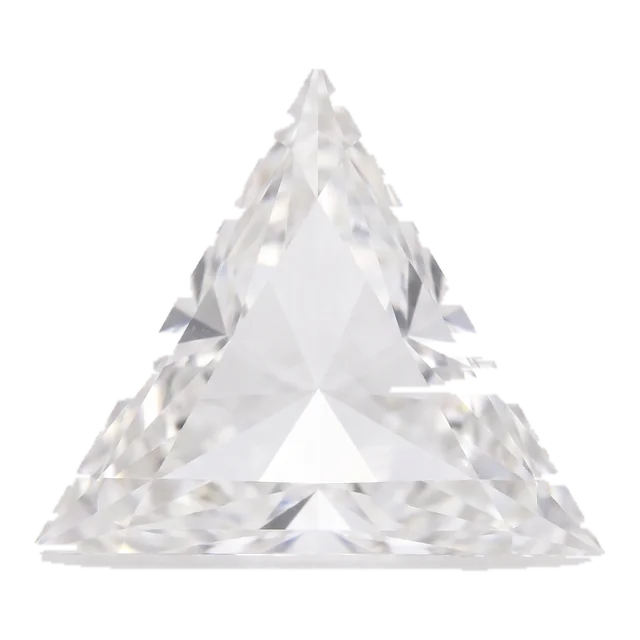
Wholesale Triangle Cut Diamonds
Natural and lab-grown are two separate lines here, never mixed on one certificate or one price list.
Straight sides, three corners, no curve anywhere. That is what separates a triangle cut from a trillion, and it is not a small distinction. A straight edge sits flush against another straight edge, which is why triangles work in geometric and mosaic designs where a trillion leaves a gap.
The buyers are designers building angular pieces, setters fitting stones against a flat-edged center, and anyone doing deco or modernist work. It is a small, deliberate market. Nobody wanders into a triangle cut by accident, which makes it an easy shape to serve well if you actually keep it in stock.
We hold over 50 triangle cuts, all lab-grown, listed separately from our trillion shelf so a straight-edged order never gets filled with a curved stone. Both step-cut and brilliant faceting are represented.
Buying Triangle Diamonds Wholesale
Confirm the edges are actually straight. Listings across the market use triangle and trillion loosely, and a slightly convex side will ruin a design that depends on stones meeting flush. We separate the two categories, but always look at the face-up image before ordering for a fitted piece.
The corners chip. Three sharp points on a straight-sided stone is the most exposed geometry in the box, and setting is when the damage usually happens. Check the plot for existing chips, avoid extremely thin girdles at the points, and plan on bezel or corner-prong setting rather than standard prongs.
Buy on millimeter for anything fitted. A triangle used as a side stone has to match the center's edge exactly, and depth has to let the tables sit level. Carat weight will not tell you either of those things. Send the measurements and we will pull to them.
The shelf is lab-grown and nearly all IGI graded. Matched pairs are available in lab-grown material, which is the practical way to buy for symmetrical work, since two triangles that disagree by a fraction of a millimeter are obvious once they are set on either side of a center stone.
Frequently Asked Questions
What is the difference between a triangle cut and a trillion?
Triangle cuts have straight sides, trillions have slightly curved ones. In practice that means a triangle sits flush against another flat edge and a trillion does not, which matters in geometric and mosaic designs. We list them as separate shapes so an order for one never arrives as the other.
Are triangle diamonds used as side stones?
Yes, and that is most of the demand, though they also work as centers in angular designer pieces. As a side stone the long edge has to match the width of the center stone and the depth has to let both tables finish level. Order by measurement rather than by weight.
How should triangle cut diamonds be set?
Bezel or corner prongs. Three sharp corners on a straight-sided stone is the most vulnerable geometry we sell, and most chipping happens during setting rather than during wear. Use a setter who has handled pointed stones before.
Do you carry natural triangle cut diamonds?
No, the whole shelf is lab-grown. Angular geometric cuts in natural material are rare, expensive, and effectively impossible to supply in matched pairs at consistent sizes. Every stone here is separate from our natural line and nearly all carry IGI reports.
How do I buy these wholesale?
Open a free trade account and prices appear across the catalog when you sign in. For fitted work, call with your center stone's dimensions and we will match against them here rather than shipping something that misses by a tenth of a millimeter.
Related Shapes
Related reading: How matched pairs are actually matched.