
Wholesale, Lab-Grown
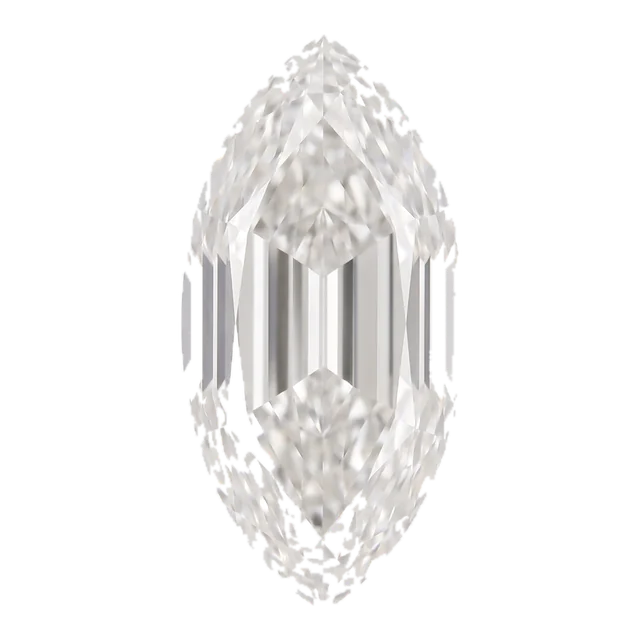
Wholesale Marquise Step Cut Diamonds
Natural and lab-grown are two separate lines here, never mixed on one certificate or one price list.
The marquise outline with step facets is a harder cut than it looks. Two points, a long belly, and facet rows that have to stay parallel while the width of the stone changes constantly. Done well, the result is a long ladder of light running from tip to tip. Done badly, the rows wander and the stone looks bent.
Designers are the market. This cut shows up in bezels, in navette-style deco pieces, and in rings where a client wants something long and quiet rather than long and sparkly. It also sits well alongside baguettes and other step cuts, since the facet language matches.
There is no natural production behind this style, so the shelf is lab-grown. We stock over 80 marquise step cuts, which is small in absolute terms and deep for a cut this specialized. Most dealers cannot offer it at all without a cutting order.
Buying Marquise Step Diamonds Wholesale
Both points are the risk, and this cut has two of them. Step facet rows converge hard at each tip, which leaves very little material at the very end. Check the plot at both ends for chips and naturals, insist the setter uses V-prongs or a full bezel, and be skeptical of any stone priced well under its group.
Row alignment across the centerline is the quality test. Draw an imaginary line down the length of the stone and confirm the facet rows meet it at the same height on both sides. Any drift is far more visible in a step cut than in a brilliant, because there are no small facets to distract the eye.
Clarity behaves like an emerald cut and the long open belly is the exposed area. Buy VS2 or cleaner in anything over a carat, and look specifically at the widest part of the stone on the plot, since that is where a crystal has the most room to be seen.
Everything in this cut is lab-grown, and an IGI report comes with nearly every stone. Matched pairs are available in lab-grown material and are the sensible starting point for any symmetrical design, because matching row alignment across two singles is exacting work.
Length-to-Width Ratio
1.80 to 2.10 length to width is the workable range, similar to a brilliant marquise.
Longer than 2.20 the facet rows near each tip shrink to almost nothing and the cutting quality gets very hard to judge, let alone execute.
Shorter than 1.70 the stone loses the navette silhouette that made someone ask for a marquise in the first place.
Frequently Asked Questions
What is a marquise step cut diamond?
A marquise step cut has the pointed navette outline of a marquise with step faceting, meaning long parallel facet rows instead of brilliant faceting. It reads flatter and quieter than a standard marquise and shows broad planes of light rather than sparkle. The cut exists almost entirely in lab-grown material.
Is a marquise step cut harder to cut than a regular marquise?
Yes, meaningfully. Keeping step facet rows parallel while the stone narrows toward two points is exacting, and errors show plainly because there are no small facets to hide them. That difficulty is why the shape is uncommon and why judging row alignment matters more than judging grades here.
How should marquise step cuts be set?
V-prongs over both points, or a full bezel. Step facet rows converge at each tip and leave very little material there, so an unprotected point will eventually chip. Confirm the setting plan before you sell the stone, since this catches setters who are used to brilliant marquises.
How do I buy marquise step cuts at wholesale?
Sign up for a free trade account and prices appear on every listing once you log in. This shelf is small and specialized, so if you need a specific length or a matched pair, calling gets you an answer faster than filtering the list.
Related Shapes
Related reading: our diamond buying and grading guides.