
Wholesale, Lab-Grown
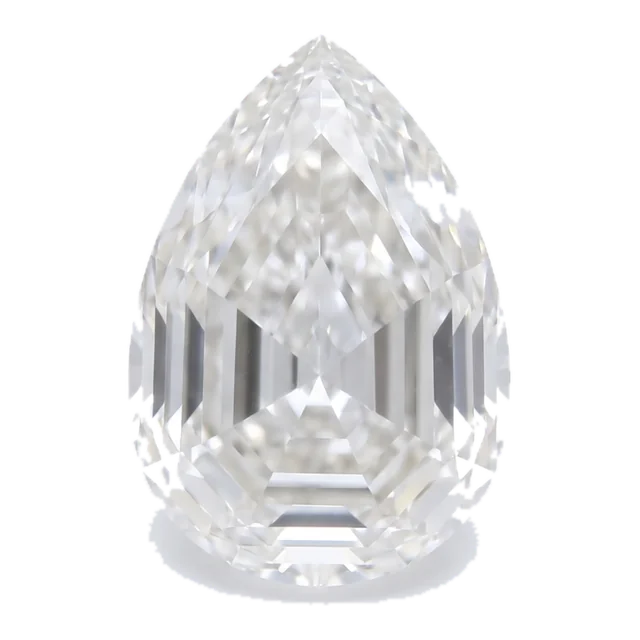
Wholesale Pear Step Cut Diamonds
Natural and lab-grown are two separate lines here, never mixed on one certificate or one price list.
Pear step cuts came out of the same wave of cutting that produced oval and marquise step cuts: familiar outlines rebuilt with long parallel facets instead of brilliant ones. The teardrop silhouette stays, the sparkle is replaced by broad flat planes, and the stone reads architectural rather than romantic.
Designers use them where a brilliant pear would be too busy. Bezel settings, north-south pendants, and pieces where the metalwork is doing the talking all suit this cut, because a step cut sits quietly next to detailed work while a brilliant competes with it.
Cutting steps into a shape with a curve at one end and a point at the other is difficult, and there is no natural production behind it, so the shelf is lab-grown. We stock over 90 of them, which is a real position for a cut most dealers will not have at all.
Buying Pear Step Diamonds Wholesale
The point is where step cutting gets hard and where damage happens. Facet rows converge as the stone narrows, so any error compounds toward the tip. Check the plot for chips or naturals at the point and confirm the setter is bezeling or using a V-prong. A bare step cut point in a plain prong is a claim waiting to happen.
Look at how the rows follow the curve on the rounded end. Both shoulders should carry matching facet rows at matching heights. If one shoulder shows a row the other does not, the outline will look tilted even though the measurements say it is symmetrical.
Clarity is judged the way you would judge an emerald cut. The flat open planes leave nothing to hide behind, and the wide end of a pear step gives an inclusion plenty of room to be seen. Buy a grade tighter than you would for a brilliant pear of the same size.
Everything on this shelf is lab-grown and nearly all of it is IGI graded. For drop earrings, look at matched pairs rather than singles, since matching two step cut pears on both outline and row alignment is significantly harder than matching two brilliants.
Length-to-Width Ratio
1.50 to 1.70 length to width works best for this cut, slightly longer than a classic brilliant pear.
The extra length gives the facet rows room to develop between the shoulder and the point, which is where the cut earns its look.
Below 1.40 the rows crowd together near the tip and the stone can read as a badly proportioned emerald cut instead of a pear.
Frequently Asked Questions
What is a pear step cut diamond?
A pear step cut has the teardrop outline of a pear with step faceting, meaning long parallel facets rather than the many small facets of a brilliant. It looks flatter and calmer than a standard pear and shows broad planes of light instead of sparkle. It is a modern lab-grown cut.
Is a pear step cut more fragile than a brilliant pear?
The point carries the same risk in both, and step cutting does not make it worse on its own. What matters is the girdle thickness at the tip and the setting. Bezel or V-prong the point, and check the grading plot for existing damage there before buying.
Are pear step cuts available in natural diamonds?
No. This is a modern cutting style with no meaningful natural supply, so all over 90 stones on our shelf are lab-grown. A client who wants a natural stone with a similar restrained look is better pointed toward a natural emerald cut.
How do I buy pear step cuts wholesale?
Free trade account, then sign in and the price shows on every stone. We deal with the trade only. Call the office if you want two matched for earrings or need a specific ratio that is not currently on the live list.
Related Shapes
Related reading: our diamond buying and grading guides.