
Mixing lab-grown and natural in one piece
A natural center with lab-grown sides is a normal order. What it saves, whether the two will match, and exactly how the paperwork has to read.
Key takeaways
- Mixing origins in one piece is allowed; failing to disclose it clearly is not.
- Put a qualifier such as laboratory grown immediately before the word diamond, in the same size type, on the tag and on every document.
- Never combine origins into one total diamond weight on an invoice, an appraisal or an insurance schedule.
- Lab-grown side stones commonly run whiter and cleaner than natural melee, so a mixed piece needs a viewing rather than a paper match.
- On a typical three stone ring the sides are 0.20 to 0.40 carats total, so the saving is real but modest, and the disclosure obligation is the same either way.

A jeweler calls with a natural oval already chosen and a budget that will not stretch to a matched pair of natural baguettes beside it. Grown baguettes solve the money problem in one move. Whether that is a good idea depends entirely on how the piece is documented, and that part is not complicated once you have done it twice.
Is it allowed to mix lab-grown and natural in one piece?
Yes. What is not allowed is leaving the customer unclear about it. The federal guidance for the jewelry trade is about description rather than construction. Build whatever the piece needs; say plainly which stones are grown.
The rules that matter in practice are short. A qualifier such as laboratory grown or laboratory created goes immediately before the word diamond. It has to be as prominent as the words around it, not a footnote. The word diamond on its own means a natural stone. Words like real, genuine and natural cannot be attached to grown material.
Everything else follows from that. Say it on the tag, say it on the quote, say it on the invoice, and say it in the same words each time.
When does mixing actually make sense?
When the sides have to be a calibrated matched pair. That is where natural goods get expensive, because a cutter had to make two small stones agree on four dimensions. Grown material makes that agreement cheaper to produce.
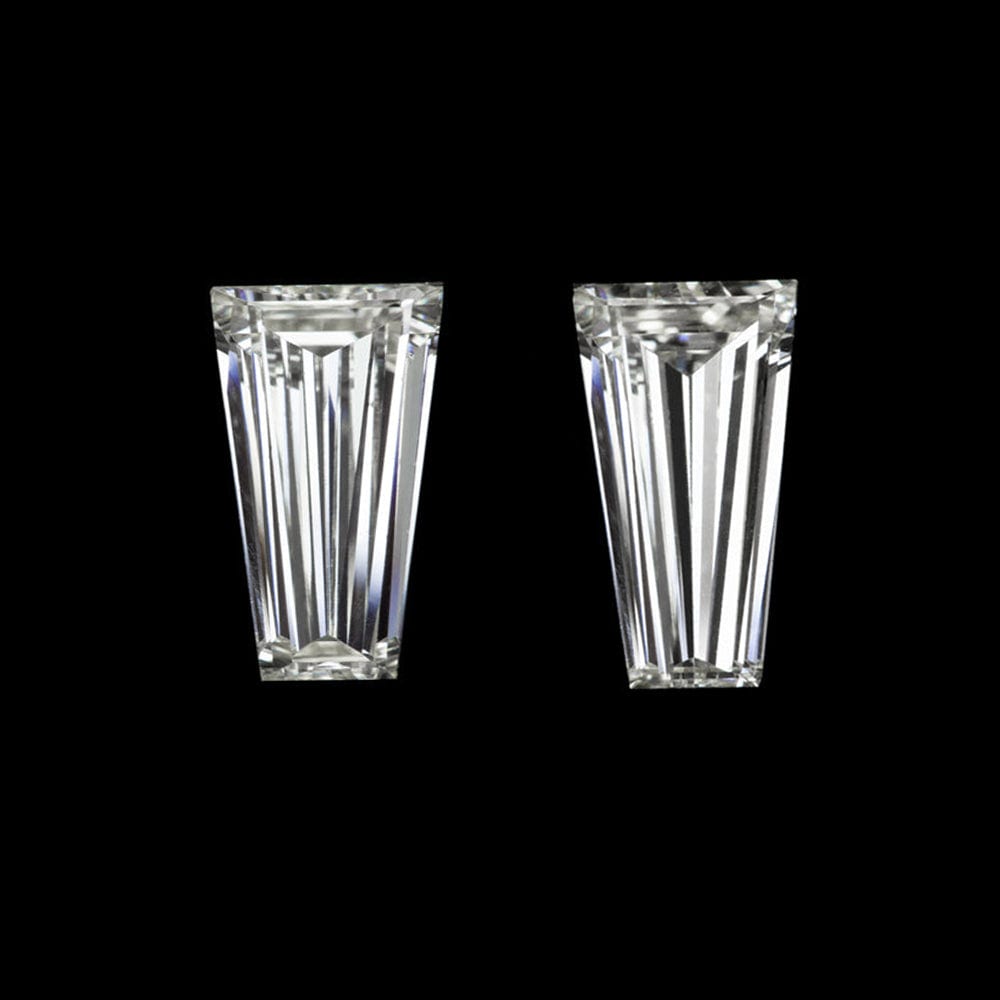
The other common case runs the opposite direction: a grown center with natural melee, when the shop already has natural melee in stock and no reason to buy a second parcel. Both are normal. Both need the same paperwork.
The case that rarely makes sense is mixing origins inside the same row. Two grown baguettes on one shoulder and two natural on the other is a disclosure headache with no upside.
Will a lab-grown side stone match a natural center?
Usually, but check the stones rather than the grades. Grown material is commonly available whiter and cleaner for the same money, so the risk is not that the sides are worse. It is that they are noticeably whiter than the center.
That is the same trap as any mismatch, and it runs the same way: sides whiter than the center make the center look yellow. Matching side stone color to the center stone has the tolerance table, and it applies unchanged when the origins differ.
Two extra things to look at on grown sides. Some material carries a faint grey or brown cast that no letter grade describes, and it shows most in a step cut with an open table. And fluorescence differs, so check the whole layout under a UV lamp before anything is set.
How much does mixing actually save?
Real money, but less than people expect, because the sides are small. A typical three stone layout carries 0.20 to 0.40 carats of side stones in total. Grown goods trade at a small fraction of the natural per carat price, so the saving is meaningful against the side stones and modest against the ring.
| Build | Where the saving is | What to watch |
|---|---|---|
| Natural center, grown sides | The matched calibrated pair | Sides reading whiter than the center |
| Grown center, natural melee | Nothing; you are using stock on hand | Melee parcel range against a very white center |
| All grown | The center, which is most of the budget | Nothing on disclosure, since one origin is simpler |
| All natural | Nothing; this is the reference price | Lead time on matched pairs |
Run the arithmetic before you propose it. If the grown sides save a modest amount on a five figure ring, the customer may prefer the simpler story. If they save enough to move the center up a size, that is a conversation worth having. How wholesale diamond pricing works covers why the two markets move independently.
How should the invoice and the tag read?
One line per origin, each line naming what it is. The failure mode is a single line reading diamonds, 1.78 ct total weight. That line is wrong even if you said the right thing out loud at the counter.
We keep the two lines separate on every document we issue, and we do not combine natural and grown into one weight on an invoice, a memo or a packing note. The report number sits on the line it belongs to.
Carry the same split onto the appraisal and the insurance schedule. An appraiser handed a combined weight will either value the whole piece as grown or come back with questions, and both cost you a week. If you are reading the reports to build the layout, reading a diamond report for calibrated layouts covers which fields you actually need.
What do you tell the customer?
Say it first, in one sentence, before price comes up. The center is a natural diamond and the two side stones are laboratory grown. Customers accept that immediately when it leads, and resent it when it surfaces at the end.
Explain the reason in trade terms, because it is a good reason: matched calibrated pairs are the expensive part of a three stone ring, and using grown stones there puts the money into the center where the customer will see it.
Then give them the papers. Report numbers on the natural stone, the origin statement on the grown ones, and an invoice they can hand an insurer without a phone call. If you want the background on which lab grades which line, see GIA and IGI, the real-world split, and for parcels rather than pairs, how to spec melee so it matches. Both lines, natural and grown, are listed separately in the inventory, from rounds to ovals to half moons.
Frequently asked questions
Can you put lab-grown side stones on a natural center?
Yes, and it is a common order. The requirement is disclosure. Every document and the tag has to say which stones are laboratory grown, and the two origins cannot be blended into one combined diamond weight anywhere on the paperwork.
How do you have to describe a lab-grown diamond?
With a clear qualifier immediately before the word diamond, in type as prominent as the rest of the description. Laboratory grown and laboratory created are both accepted. The word diamond used alone means a natural stone, and terms like real, genuine and natural cannot be used for grown material.
Will the lab-grown sides look different from the natural center?
They can. Grown side stones are usually available whiter and cleaner for the money, and some grown material carries a faint grey or brown undertone that a letter grade does not describe. Look at the actual stones together under one light before setting rather than matching on paper.
Does mixing hurt the value of the piece?
It changes what the piece is, and the appraisal should say so. A natural center holds its own market; the grown sides are valued as grown. Trouble only arises when the paperwork is vague, because then the whole piece gets treated at the lower value.
Sources
- US Federal Trade Commission, Jewelry Guides business guidance
- Photo: "Diamond Macro 3" by stephend9, CC BY 2.0, via Flickr, resized
- Photo: "Diamond Balance Scale 0.01 - 25 Carats Jewelers Measuring Tool" by Sally V, CC BY-SA 4.0, via Wikimedia Commons, resized
- Photo: Matched pair of loose laboratory grown tapered baguettes, Ivy & Rose
Related reading


HV Diamonds is a wholesale loose diamond dealer in Los Angeles. Natural and lab-grown are kept as separate lines. Prices show on every stone once you are signed in, and an account is free.
Need something that is not on the list? Call the office at 213-612-0324 or send a quote request with the shape, the size band and the deadline.