
Tapered baguettes, how to size the taper
A tapered baguette has three measurements and one angle. Here is how to read them, how to match the taper to the shank, and what tolerance a real pair holds.
Key takeaways
- A tapered baguette is quoted as three numbers, length by wide end by narrow end, and all three have to be on the order.
- Taper angle is half the width difference over the length; most commercial stones land between roughly 3 and 6 degrees per side.
- Match the narrow end to the shank width at the shoulder within about 0.2 mm or the setter is left filing a step.
- Each baguette usually runs about 40 to 55 percent of the length of the center stone.
- A real pair matches within roughly 0.05 mm on every dimension and the same taper angle, not just the same carat weight.

Baguettes are the side stone that most often arrives wrong, and almost never because the color or the clarity missed. They arrive wrong because somebody ordered two numbers when the stone has three, or ordered a taper that does not agree with the shank it is going onto. Both are avoidable in a two minute check.
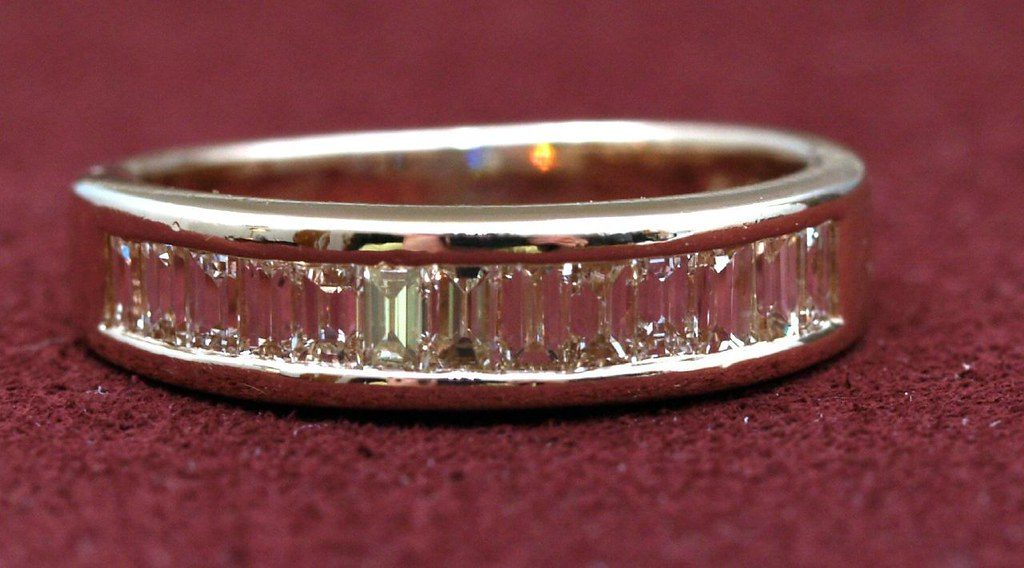
What does the taper on a tapered baguette actually mean?
It is the difference between the two widths, expressed as an angle. A straight baguette has parallel long sides. A tapered baguette is wider at the end that meets the center and narrower at the end that meets the shank, so the shoulder of the ring closes down as it goes.
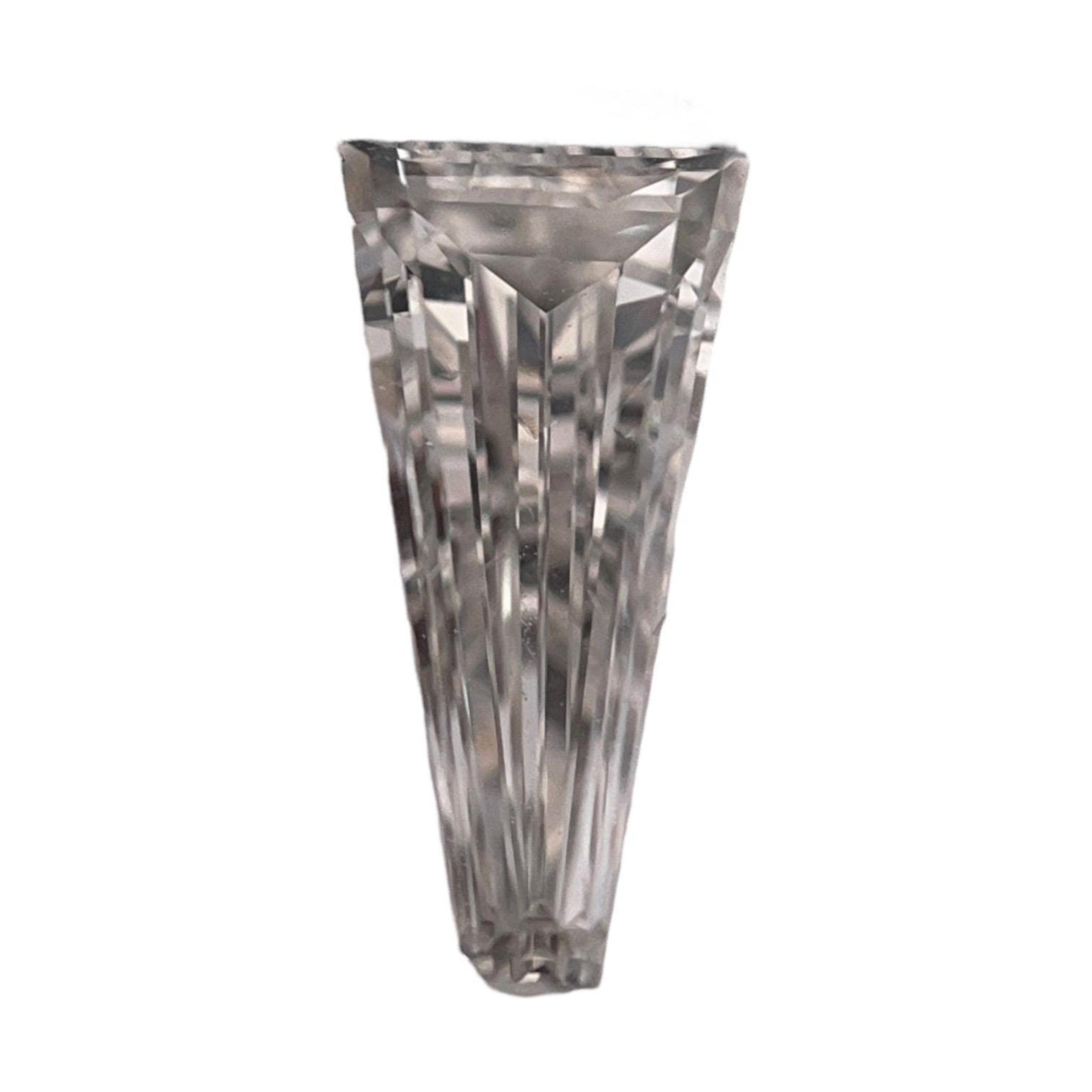
That is why the trade quotes three numbers. A pair described only as 4.00 by 2.00 mm tells you nothing about how fast it narrows, and two stones with the same first two numbers can look completely different on a ring.
How do you read a pair off a measurement line?
Read length first, narrow end second, wide end last. Length decides whether the layout is balanced. The narrow end decides whether the stone meets the shank cleanly. The wide end is the one most people read first and it is the least load bearing of the three.
When a dealer sends you a pair, ask for both stones separately rather than one line for the pair. Two baguettes averaged into a single measurement hides exactly the mismatch you are trying to avoid.
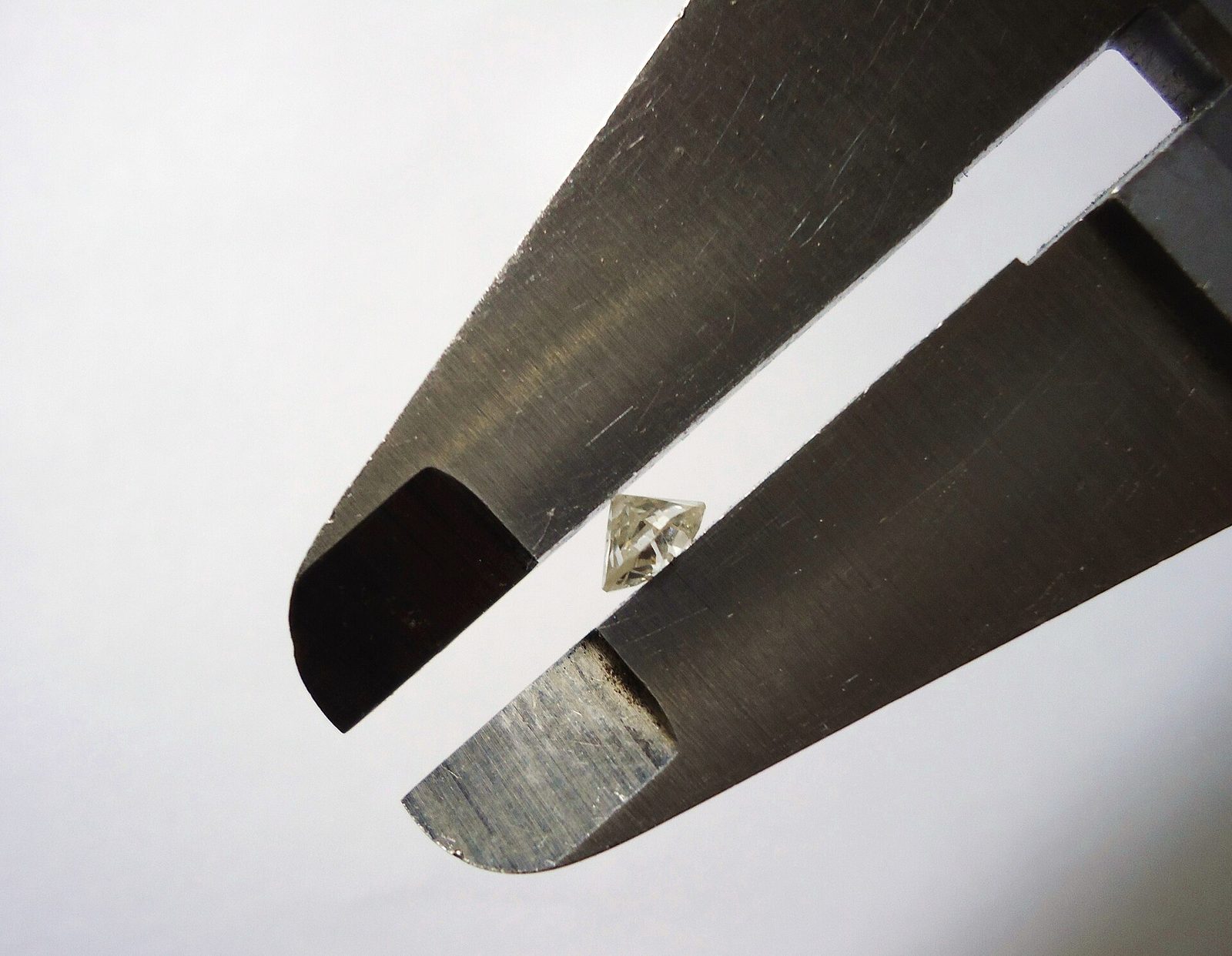
Depth is the fourth number and it is worth asking for. A baguette much deeper than the seat you can cut sits high, and a very shallow one sinks and goes dark. Roughly 55 to 70 percent of the wide end width is a normal depth for a commercial stone.
What taper angle should you order?
Most commercial tapers land between about 3 and 6 degrees per side. Below 3 degrees the stone reads as a straight baguette that happens to be slightly off. Above about 8 degrees the taper is a design statement, and it needs a shank that narrows just as fast.
The arithmetic is simple enough to do at the counter. Subtract the narrow end from the wide end, halve the result, and take it over the length. These are the sizes that turn up most often.
| Nominal size, mm | Approx. weight each | Taper per side | Suits a center around |
|---|---|---|---|
| 3.00 x 1.50 x 1.00 | 0.05 to 0.07 ct | about 4.8 degrees | 0.50 to 0.75 ct |
| 3.50 x 1.75 x 1.30 | 0.07 to 0.10 ct | about 3.7 degrees | 0.75 to 1.00 ct |
| 4.00 x 2.00 x 1.50 | 0.10 to 0.14 ct | about 3.6 degrees | 1.25 to 1.75 ct |
| 4.00 x 2.00 x 1.20 | 0.09 to 0.13 ct | about 5.7 degrees | 1.25 to 1.75 ct, fast shoulder |
| 5.00 x 2.50 x 1.70 | 0.18 to 0.24 ct | about 4.6 degrees | 2.00 to 2.50 ct |
| 6.00 x 3.00 x 2.00 | 0.30 to 0.40 ct | about 4.8 degrees | 3.00 ct and up |
How do you match the taper to the shank?
The narrow end and the shank should agree within about 0.2 mm. The narrow end is a joint, not a decoration. When it matches the shank width at the shoulder, the eye follows one continuous line from the finger up to the center.
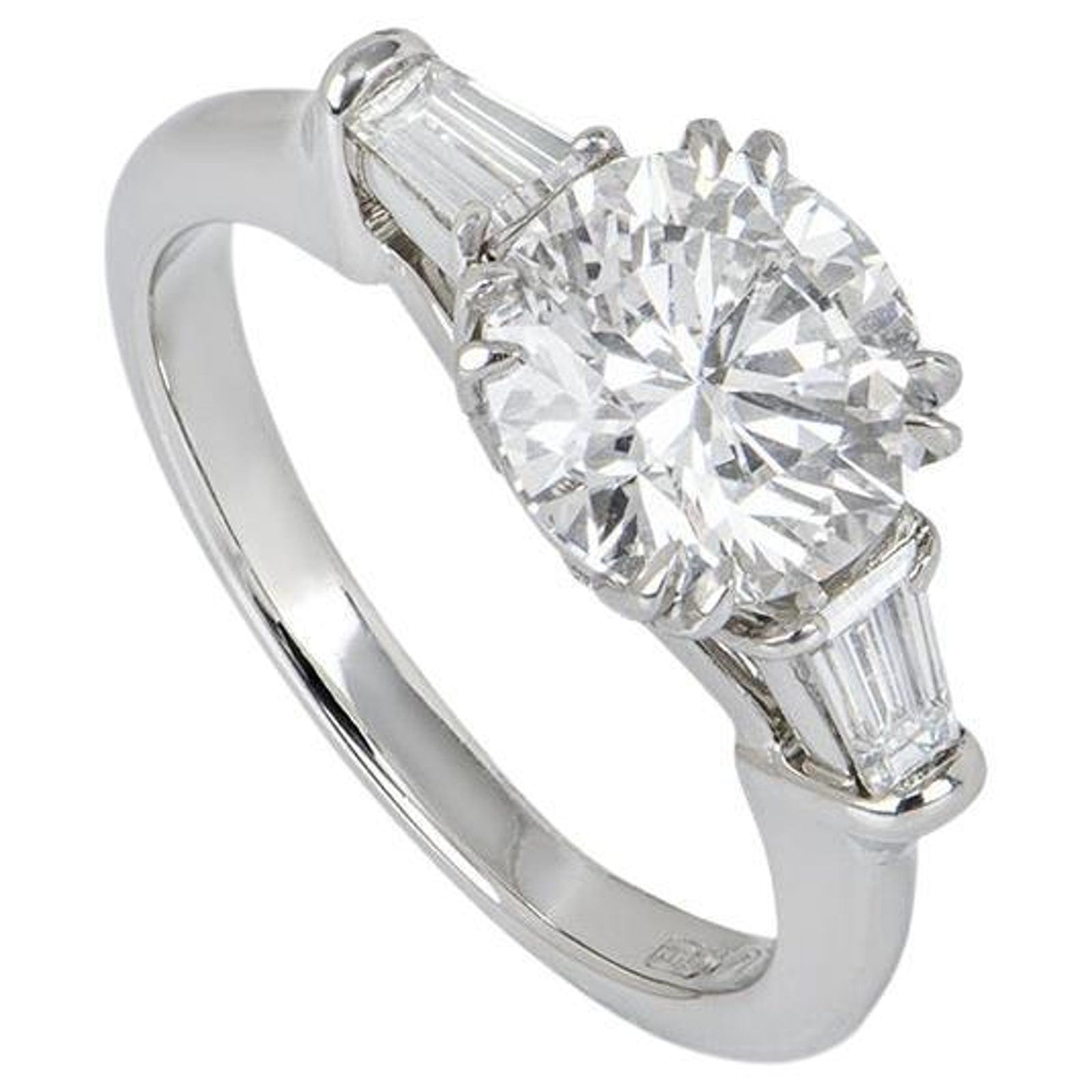
This is the failure everybody has seen. A 1.80 mm narrow end dropped onto a 1.20 mm shank leaves a shelf on each side of the ring. The setter can chase it with a file and a polishing wheel, but the metal has to come from somewhere and the shank ends up thinner than it should be.
Work in the other direction when you can. Decide the shank first, then order the narrow end to it. Changing a shank is a morning at the bench; changing a matched pair of diamonds is a week and a restocking conversation.
How long should the baguettes be next to the center?
About 40 to 55 percent of the length of the center stone. On an 8.50 mm oval that is roughly 3.5 to 4.5 mm per side. Shorter than 40 percent and the sides look like an accident; longer than 55 percent and the ring reads as a three stone band.
Add the pieces up before you order. Two 4.00 mm baguettes plus an 8.50 mm center plus two metal gaps of 0.15 to 0.20 mm comes to roughly 16.8 mm of top length. On a size 5 finger that is a lot of ring, and it is better to know before the stones are on their way.
If the layout is going to be calibrated, take the numbers off the report rather than off a photograph. Reading a diamond report for calibrated layouts walks through exactly which fields carry and which do not.
What tolerance does a real pair hold?
Roughly 0.05 mm on each dimension and the same taper angle. Weight alone is not a match. Two stones can both weigh 0.12 ct and differ by 0.4 mm in length, which is visible the moment they sit either side of a center.
Color and clarity have to agree too, and on step cuts they show more than they would on a brilliant of the same grade. Keep the pair inside one color grade and hold to VS2 or better so the open table does not put a feather on display. How diamond matched pairs are matched covers the full tolerance list, and matching side stone color to the center stone covers what happens when they do not agree.
Baguettes are not the only answer to a shoulder. A trapezoid gives you a longer contact edge against a square center, a half moon follows the curve of an oval, and a bullet points the eye back toward an emerald cut. Which one to pick is the subject of how to choose side stones. When you are ready to see live measurements rather than nominal ones, they are on every stone in the inventory.
Frequently asked questions
What do the three numbers on a tapered baguette mean?
Length, then the width of the wide end, then the width of the narrow end. A stone written as 4.00 x 2.00 x 1.50 mm is 4 mm long, 2 mm across the end that meets the center, and 1.5 mm across the end that meets the shank. Depth is quoted separately when it matters for the seat.
How do you calculate the taper angle?
Subtract the narrow end from the wide end, halve it, and take that over the length. On a 4.00 x 2.00 x 1.50 mm stone the difference is 0.50 mm, half is 0.25 mm, and 0.25 over 4.00 works out to roughly 3.6 degrees per side.
Straight or tapered baguettes beside an emerald cut?
Straight baguettes sit more naturally beside a step cut center because the parallel lines echo the center outline. Tapered baguettes read better when the shank narrows quickly or when the center is curved and the shoulder needs to close down. Both are correct; the shank decides.
Can a dealer recut a baguette to fit?
A narrow end can be brought in slightly, and a length can be shortened, but every cut costs weight and money and the pair has to stay matched. It is nearly always faster and cheaper to search for a pair that already measures what you need.
Sources
- Photo: "baguette diamond band" by paparutzi, CC BY 2.0, via Flickr, resized
- Photo: "Measuring a diamond (1)" by Mauro Cateb, CC BY-SA 3.0, via Wikimedia Commons, resized
- Photo: GIA certified 0.51 carat tapered baguette diamond, 1stDibs
- Photo: Harry Winston platinum ring with tapered baguette side stones, 1stDibs
Related reading


HV Diamonds is a wholesale loose diamond dealer in Los Angeles. Natural and lab-grown are kept as separate lines. Prices show on every stone once you are signed in, and an account is free.
Need something that is not on the list? Call the office at 213-612-0324 or send a quote request with the shape, the size band and the deadline.